eduo
visual
Nervous System
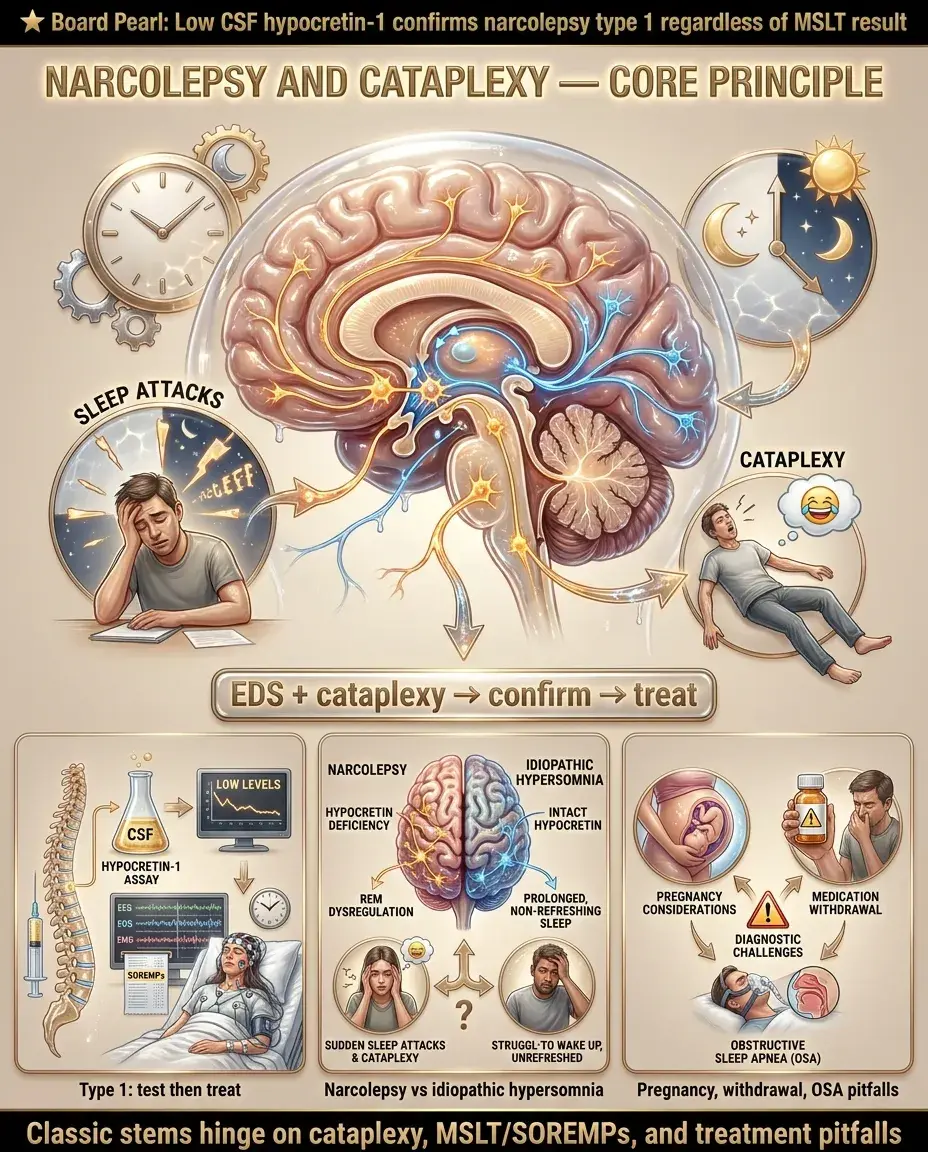
Narcolepsy and cataplexy
Narcolepsy is a chronic disorder of central hypersomnolence caused by loss of hypothalamic hypocretin (orexin)-producing neurons (Type 1) or by an unclear mechanism with preserved hypocretin (Type 2).
— Excessive daytime sleepiness (EDS) persisting ≥3 months
— Sleep attacks: sudden, irresistible episodes of falling asleep in inappropriate situations
— Cataplexy: sudden bilateral loss of muscle tone triggered by strong emotions (pathognomonic for Type 1)
— Disrupted nocturnal sleep, hypnagogic/hypnopompic hallucinations, sleep paralysis
Board pearl: Narcolepsy Type 1 (with cataplexy) = low CSF hypocretin-1 (orexin-A) ≤110 pg/mL and is strongly associated with HLA-DQB1*06:02. Type 2 lacks cataplexy and has normal hypocretin levels.

The pentad of narcolepsy (not all features required):
Additional history clues:
— Automatic behaviors (writing gibberish, driving to wrong location)
— Fragmented nocturnal sleep (paradoxically)
— Weight gain — loss of orexin → ↓ energy expenditure
— Childhood onset may mimic ADHD or behavioral disorders
Next best step: Detailed sleep history + sleep diary/actigraphy for ≥1–2 weeks before formal testing to ensure adequate habitual sleep and exclude insufficient sleep syndrome.

— Bilateral loss of muscle tone (face, jaw, neck, limbs)
— Preserved consciousness — patient can recall the event
— No postictal state (distinguishes from seizure)
— Reflexes are absent/↓ during the attack (hypotonia)
— Episodes last seconds to a few minutes
— Papilledema, cranial nerve deficits → hypothalamic/brainstem lesion
— Systemic disease: sarcoidosis, MS, anti-NMDA receptor encephalitis
Key distinction: Cataplexy vs syncope — cataplexy is emotionally triggered, consciousness is preserved, there is no loss of pulse or pallor, and recovery is immediate. Syncope involves loss of consciousness and often hemodynamic compromise.
Key distinction: Cataplexy vs atonic seizures — cataplexy has emotional trigger, preserved consciousness, no EEG epileptiform correlate.

Diagnosis requires objective testing after ≥1–2 weeks of adequate sleep (confirmed by sleep diary/actigraphy) and discontinuation of REM-suppressing medications (SSRIs, SNRIs, TCAs) for ≥2 weeks.
Step 1: Overnight polysomnography (PSG)
Step 2: Multiple Sleep Latency Test (MSLT) — performed the morning after PSG
— Mean sleep latency ≤8 minutes AND
— ≥2 SOREMPs (a SOREMP on the preceding PSG counts as one)
Board pearl: A SOREMP = REM sleep occurring within 15 minutes of sleep onset. Normal individuals do not enter REM for ~90 minutes. SOREMPs reflect the intrusion of REM phenomena (dreams, atonia) into wakefulness — this underlies cataplexy, sleep paralysis, and hallucinations.

— ≤110 pg/mL (or <1/3 of normal mean) is diagnostic of Narcolepsy Type 1 even without MSLT
— Useful when cataplexy is atypical or MSLT is equivocal
— Not required if cataplexy is unambiguous + MSLT is positive
— Present in >98% of Type 1 narcolepsy
— However, also present in ~25% of general population → high sensitivity but LOW specificity
— Useful for: negative result essentially excludes Type 1
— NOT sufficient alone for diagnosis
Narcolepsy Type 1 diagnostic criteria:
— EDS ≥3 months + definite cataplexy + positive MSLT (or low CSF hypocretin-1)
Narcolepsy Type 2 diagnostic criteria:
— EDS ≥3 months, no cataplexy, positive MSLT, normal or unknown CSF hypocretin-1
Next best step: If a patient has clear-cut cataplexy + EDS → PSG/MSLT confirms. If cataplexy is questionable → CSF hypocretin-1 can clinch the diagnosis.

Non-pharmacologic (adjunctive, always recommended):
Pharmacotherapy for EDS:
— Mechanism: promotes wakefulness (exact mechanism unclear; ↑ dopamine, histamine)
— Well tolerated; lower abuse potential than traditional stimulants
— Side effects: headache, nausea, insomnia, ↓ efficacy of oral contraceptives (CYP3A4 inducer)
— Taken at bedtime + again 2.5–4 h later
— Uniquely improves EDS AND cataplexy AND nocturnal sleep consolidation
— Side effects: nausea, enuresis, confusion, respiratory depression
— DEA Schedule III; REMS program required (high abuse potential)
Board pearl: Modafinil treats EDS but NOT cataplexy. Sodium oxybate treats both.

Cataplexy results from inappropriate intrusion of REM-associated atonia into wakefulness → treatment targets REM suppression or stabilization.
— Most effective; reduces cataplexy frequency by >60–90%
— Also consolidates sleep and ↓ EDS
— Venlafaxine (SNRI) — commonly used; ↑ norepinephrine/serotonin → suppresses REM
— Other SNRIs or SSRIs (fluoxetine)
— TCAs (clomipramine, protriptyline) — effective but more side effects
— Abrupt withdrawal of these agents can cause rebound cataplexy (status cataplecticus)
— Approved for EDS and cataplexy
— Non-scheduled (no abuse potential)
— QTc prolongation risk
Next best step: Patient with narcolepsy Type 1 needing treatment for both EDS and cataplexy → sodium oxybate (addresses both) OR modafinil (for EDS) + venlafaxine (for cataplexy).

Stepwise approach:
1. All patients: sleep hygiene + scheduled naps + driving counseling
2. EDS alone (Type 2 or mild Type 1): modafinil/armodafinil
3. EDS + cataplexy: sodium oxybate (preferred) OR modafinil + SNRI
4. Refractory EDS: add methylphenidate or dextroamphetamine (traditional stimulants)
— Higher abuse potential; scheduled substances
— Monitor HR, BP, weight
5. Solriamfetol (dopamine/NE reuptake inhibitor) — newer option for refractory EDS
— Dose-dependent ↑ BP, insomnia
Refractory cataplexy:
— ↑ sodium oxybate dose
— Combine sodium oxybate + SNRI
— Avoid abrupt withdrawal of anticataplectic agents
Board pearl: Traditional stimulants (amphetamines, methylphenidate) are second-line for EDS due to abuse potential and cardiovascular side effects. Modafinil is preferred first because of a better safety profile.
Key distinction: Stimulants help EDS but do NOT treat cataplexy. Only sodium oxybate, SNRIs/SSRIs/TCAs, and pitolisant target cataplexy.

— Cataplexy can present as "cataplectic facies" — persistent hypotonic facial expression, tongue protrusion, jaw weakness
— May be misdiagnosed as ADHD, epilepsy, depression, or behavioral disorder
— Rapid weight gain near onset is characteristic
— Modafinil first-line for EDS (used off-label in children)
— Sodium oxybate approved for age ≥7 for both EDS and cataplexy
— School accommodations: scheduled naps, extended test time, counseling
Board pearl: A child with sudden-onset excessive sleepiness + rapid weight gain + facial hypotonia → think narcolepsy Type 1. Check CSF hypocretin-1 if MSLT is inconclusive.

Pregnancy:
Elderly:
Comorbidities:
Board pearl: Obstructive sleep apnea must be excluded or treated before attributing EDS to narcolepsy.

— Sleep attacks while driving → motor vehicle accidents
— Falls during cataplectic episodes
— All narcolepsy patients must receive driving safety counseling
— Prolonged, sub-continuous cataplexy lasting hours
— Usually triggered by abrupt withdrawal of anticataplectic medications (SNRIs, TCAs)
— Management: reinstate the withdrawn medication; supportive care
— Depression, anxiety (up to 30–50%)
— Social stigma, academic/occupational impairment
— Relationship difficulties
— Sodium oxybate: respiratory depression (especially with opioids, alcohol, benzodiazepines), Na⁺ load (contains significant sodium → caution in HF, HTN)
— Stimulants: tachycardia, HTN, insomnia, dependence
— SNRIs/TCAs: serotonin syndrome risk if combined
Next best step: When discontinuing anticataplectic therapy → taper gradually to prevent rebound cataplexy/status cataplecticus.

— All patients with suspected narcolepsy for confirmatory PSG/MSLT
— Atypical presentations (late onset, no cataplexy, equivocal MSLT)
— Refractory EDS or cataplexy despite adequate pharmacotherapy
— Need for CSF hypocretin-1 testing
— Concern for structural hypothalamic lesion (secondary narcolepsy)
— Associated neurologic deficits on exam
— Consideration of anti-NMDA receptor encephalitis, MS, sarcoidosis
— Status cataplecticus
— Severe medication side effects (respiratory depression from sodium oxybate)
— Suicidal ideation from comorbid depression
— Psychiatry/psychology for comorbid mood disorders
— Occupational rehabilitation for workplace accommodations
— Social work for disability applications
Board pearl: MRI brain (focused on hypothalamus/brainstem) should be obtained in atypical narcolepsy — late onset, rapidly progressive, or neurologic signs — to rule out secondary causes.

— Most common cause of EDS; patient simply does not sleep enough
— History: <7 h/night; resolves with extended sleep
— MSLT may show short latency but no SOREMPs
— Snoring, witnessed apneas, obesity, ↑ neck circumference
— PSG shows AHI ≥5 with symptoms; no SOREMPs on MSLT (usually)
— Treat OSA first; if EDS persists → consider coexisting narcolepsy
— EDS + prolonged unrefreshing naps (unlike narcolepsy's refreshing naps)
— ↑ total sleep time (>11 h/24 h), severe sleep inertia ("sleep drunkenness")
— MSLT: mean sleep latency ≤8 min but <2 SOREMPs
— Recurrent episodes of hypersomnia + hyperphagia + hypersexuality + cognitive/behavioral changes
— Episodic; normal between episodes
— Predominantly adolescent males
Key distinction: Refreshing naps point toward narcolepsy; unrefreshing prolonged sleep favors idiopathic hypersomnia.

— No emotional trigger; loss of consciousness; postictal state
— EEG shows epileptiform discharges
— Loss of consciousness + hemodynamic changes (pallor, ↓ BP/HR)
— Positional triggers (standing), not emotional
— Variable presentation; may mimic cataplexy
— Typically longer duration, less stereotyped
— Normal EEG, no SOREMPs on MSLT
— Focal neurologic deficits; typically older patient with vascular risk factors
— No emotional trigger
— Episodes of weakness lasting hours; triggered by meals, exercise, or rest
— Check K⁺ during attack; EMG findings
Board pearl: Cataplexy is virtually pathognomonic for narcolepsy Type 1. A clear history of emotionally triggered bilateral muscle weakness with preserved consciousness + rapid recovery requires no further differential if classic.

— Persistent EDS despite adequate sleep
— Unexplained falls or episodes of muscle weakness
— Adolescent with new-onset EDS + rapid weight gain
— Recurrent motor vehicle accidents or near-misses due to sleepiness
— Self-reported measure of sleepiness across 8 situations
— Score >10 suggests excessive sleepiness; >15 is severe
— Useful for screening and monitoring treatment response
— Not diagnostic — must be followed by PSG/MSLT
— Not recommended as screening (poor specificity)
— Useful to help exclude narcolepsy Type 1 (negative test makes Type 1 very unlikely)
— Pandemrix (AS03-adjuvanted) linked to ↑ narcolepsy incidence in Europe
— Current influenza vaccines have no established association
Board pearl: Narcolepsy is often delayed 8–15 years from symptom onset to diagnosis. Maintain high clinical suspicion in young patients with EDS.

— Assess symptom control: frequency of sleep attacks, cataplexy episodes
— Epworth Sleepiness Scale for objective tracking
— Side effect monitoring for medications
— Modafinil: LFTs if hepatic concerns; ensure adequate contraception (↓ OCP efficacy)
— Sodium oxybate: Na⁺ intake assessment (high sodium content), respiratory status, weight
— Stimulants: HR, BP, weight, signs of dependence/misuse
— Pitolisant: ECG for QTc interval
— Reassess at each visit; state-specific reporting laws apply
— Encourage patients to avoid driving during known periods of high sleepiness
— Screen for depression, anxiety at each visit
— Academic/occupational accommodations under disability protections
— Support groups and patient education resources
Next best step: Counsel all patients on the legal obligation to report narcolepsy diagnosis for driving licensure in states that require physician reporting.

— Narcolepsy patients have 3–7× ↑ risk of motor vehicle accidents
— Some jurisdictions mandate physician reporting of conditions impairing driving
— Ethical duty: discuss risk, document counseling, encourage self-restriction until treatment is optimized
— Patients should avoid occupations with high risk of injury from sudden sleep/cataplexy (heavy machinery, commercial driving, piloting)
— Americans with Disabilities Act (ADA): narcolepsy qualifies as a disability → reasonable accommodations (flexible schedule, nap breaks)
— Sodium oxybate — REMS program required; single pharmacy distribution; abuse potential
— Stimulants — Schedule II; prescription monitoring program (PMP) checks
— Avoid stigmatizing patients who require these medications
— Discuss teratogenicity of modafinil in women of childbearing age
— Discuss respiratory depression risk with sodium oxybate, especially with concomitant CNS depressants
Board pearl: Always document driving counseling in the medical record for narcolepsy patients — it is a medicolegal imperative.