top of page

Endocrine

Cushing syndrome: diagnosis and management

Clinical Overview and When to Suspect Cushing Syndrome

Cushing syndrome = clinical manifestations of chronic glucocorticoid excess, regardless of source.

— Multiple features of hypercortisolism cluster together (especially catabolic signs: thin skin, wide purple striae, proximal myopathy, easy bruising)

— Unexplained osteoporosis in a young patient

— Adrenal incidentaloma with metabolic features

— Hypokalemic metabolic alkalosis in the right clinical context

— Exogenous glucocorticoids (most common overall — always exclude first)

— ACTH-dependent (~80% of endogenous): Cushing disease (pituitary adenoma ~70%), ectopic ACTH (small cell lung CA, carcinoid ~10%)

— ACTH-independent (~20%): adrenal adenoma, adrenal carcinoma, bilateral adrenal hyperplasia

Board pearl: The most common cause of Cushing syndrome is iatrogenic (exogenous steroids). The most common cause of endogenous Cushing syndrome is a pituitary corticotroph adenoma (Cushing disease).

Classic patient: 30–50-year-old woman with progressive central obesity, moon facies, dorsal fat pad, abdominal striae, proximal muscle weakness, easy bruising, and new-onset HTN/DM
Suspect Cushing syndrome when:
Etiologies:
Solid White Background
Presentation Patterns and Key History Findings

History clues:

— Exogenous steroid use (oral, inhaled high-dose, topical potent, intra-articular)

— Rapid weight gain over months

— Family history of MEN-1 (pituitary tumors)

— Smoking history (ectopic ACTH — small cell lung cancer, bronchial carcinoid)

Key distinction: Discriminatory features (favor Cushing over simple obesity): purple striae >1 cm, proximal myopathy, easy bruising, unexplained osteoporosis.

Central (truncal) obesity with thin extremities → cortisol promotes visceral fat deposition + peripheral muscle wasting
Moon facies, dorsocervical fat pad ("buffalo hump"), supraclavicular fat pads
Skin changes: wide (>1 cm) violaceous/purple striae (abdomen, axillae, thighs), thin fragile skin, easy bruising, poor wound healing, acne, hyperpigmentation (if ACTH-dependent)
Proximal muscle weakness: difficulty rising from a chair, climbing stairs
Metabolic: new-onset or worsening DM, dyslipidemia, HTN
Neuropsychiatric: depression, insomnia, cognitive dysfunction, emotional lability
Reproductive: menstrual irregularity, hirsutism, ↓ libido, erectile dysfunction
Bone: osteoporosis, vertebral compression fractures, avascular necrosis
Immune: recurrent infections (opportunistic — Pneumocystis risk at high cortisol levels)
Solid White Background
Physical Exam Findings and Phenotypic Clues

— Wide (>1 cm) purple/violaceous striae — highly specific

— Thin, atrophic skin ("cigarette paper" quality)

— Ecchymoses without significant trauma

— Facial plethora

— Acanthosis nigricans (insulin resistance)

Board pearl: Hyperpigmentation + hypokalemia + very high cortisol → think ectopic ACTH secretion (often small cell lung cancer or bronchial carcinoid). These patients may present acutely without classic cushingoid habitus because the disease progresses rapidly.

Central obesity: ↑ waist-to-hip ratio
Skin exam:
Proximal muscle testing: ask patient to rise from squat without using arms; assess hip flexor and shoulder girdle strength
Hypertension — present in ~80%
Dorsocervical and supraclavicular fat pads — palpate specifically
Peripheral edema
Hirsutism, acne (androgen co-secretion particularly in adrenal carcinoma)
Visual field defect: bitemporal hemianopia suggests pituitary macroadenoma
Hyperpigmentation: ↑ ACTH stimulates melanocytes → seen in ectopic ACTH and Cushing disease, NOT in adrenal tumors
Solid White Background
Diagnostic Workup — Step 1: Confirm Hypercortisolism

Before any testing → rule out exogenous glucocorticoid use (history!).

First-line screening tests (need ≥2 abnormal for diagnosis):

Interpretation logic:

— Normal HPA axis: exogenous dex → ↓ ACTH → ↓ cortisol

— Cushing syndrome: cortisol remains elevated despite dex

Next best step: If clinical suspicion is high and initial screening is positive → confirm with a second test before proceeding to localization.

Board pearl: False positives on DST occur with: OCPs (↑ CBG), alcoholism (pseudo-Cushing), depression, obesity, sleep apnea, and CYP3A4 inducers (phenytoin, rifampin → rapid dex metabolism).

24-hour urine free cortisol (UFC): ≥3× upper limit of normal is highly suggestive; collect on ≥2 occasions
Late-night salivary cortisol (×2): loss of normal diurnal nadir (cortisol should be lowest at 11 PM–midnight); ↑ values suggest autonomous secretion
1-mg overnight dexamethasone suppression test (DST): give 1 mg dexa at 11 PM → measure serum cortisol at 8 AM next morning; normal = cortisol <1.8 μg/dL; failure to suppress → abnormal
If results are equivocal → consider 2-day low-dose DST (0.5 mg q6h × 48h) or repeat testing
Solid White Background
Diagnostic Workup — Step 2: Determine the Etiology (Localization)

Once hypercortisolism is confirmed → measure plasma ACTH:

— Pituitary (Cushing disease) vs. ectopic ACTH

Next best step: High-dose DST (8 mg overnight) or CRH stimulation test

◦ Cushing disease: cortisol suppresses >50% (pituitary adenoma retains partial feedback)

◦ Ectopic ACTH: no suppression (autonomous, no feedback sensitivity)

— Pituitary MRI with gadolinium: identifies adenoma (~60% sensitivity for microadenoma)

— If MRI negative or equivocal → bilateral inferior petrosal sinus sampling (BIPSS): gold standard to distinguish pituitary vs. ectopic

◦ Central-to-peripheral ACTH ratio ≥2:1 (basal) or ≥3:1 (after CRH) → pituitary source

— Adrenal source → CT abdomen

— Unilateral mass: adenoma (small, smooth) vs. carcinoma (large >4 cm, irregular, calcified)

— Bilateral enlargement: bilateral macronodular hyperplasia, PPNAD (primary pigmented nodular adrenal disease)

Board pearl: BIPSS is the gold standard for distinguishing Cushing disease from ectopic ACTH when imaging is inconclusive. It is NOT a screening test — only performed after hypercortisolism is confirmed and ACTH is elevated.
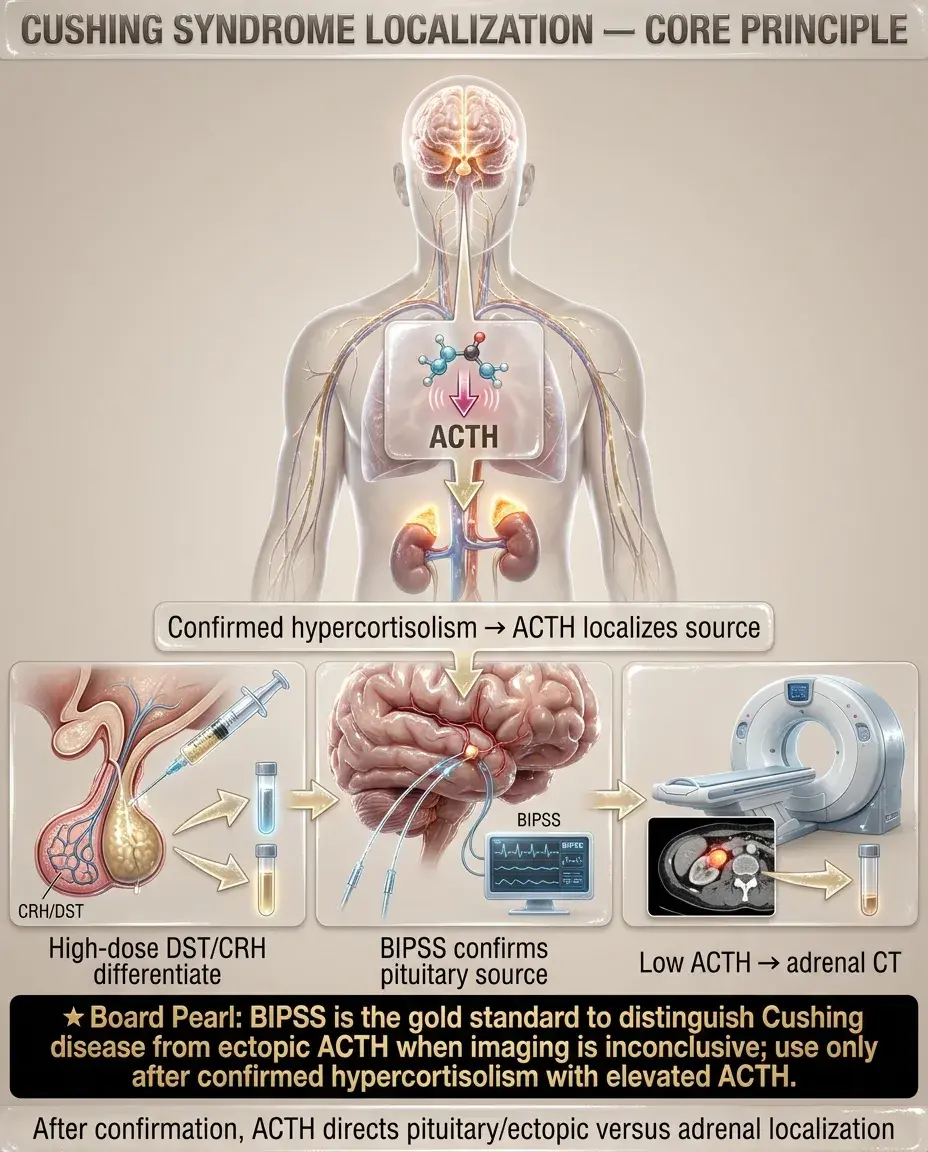
ACTH-dependent (ACTH >20 pg/mL):
ACTH-independent (ACTH <5 pg/mL):
Solid White Background
First-Line Management — Cushing Disease (Pituitary Source)

— Remission rates: 70–90% for microadenomas, lower for macroadenomas

— Postoperative assessment: serum cortisol <2 μg/dL within 72 hours indicates remission (adrenal suppression = the remaining normal corticotrophs were suppressed by chronic hypercortisolism)

— Patients need glucocorticoid replacement (hydrocortisone) postoperatively until HPA axis recovers (months to >1 year)

— Repeat TSS

— Radiation therapy (stereotactic radiosurgery or conventional): effect delayed 3–5 years; medical therapy needed as bridge

— Medical therapy (steroidogenesis inhibitors): ketoconazole, metyrapone, osilodrostat

— Bilateral adrenalectomy: definitive cure but last resort → lifelong adrenal insufficiency replacement + risk of Nelson syndrome (↑ ACTH → pituitary tumor enlargement + hyperpigmentation)

Next best step after confirmed Cushing disease: Refer to experienced pituitary neurosurgeon for TSS.

First-line treatment: Transsphenoidal surgery (TSS) — selective adenomectomy by experienced neurosurgeon
If surgical failure or recurrence:
Solid White Background
Management — Ectopic ACTH and Adrenal Causes

Ectopic ACTH syndrome:

— Medical adrenal blockade: ketoconazole, metyrapone, mitotane, etomidate (IV, for emergent control)

— Bilateral adrenalectomy if medical therapy fails and tumor is unresectable

Adrenal adenoma:

Adrenal carcinoma:

Bilateral adrenal hyperplasia (ACTH-independent macronodular hyperplasia, PPNAD):

Board pearl: Etomidate is the only IV agent that rapidly lowers cortisol — used in ICU settings for severe Cushing with life-threatening complications (sepsis, psychosis, uncontrolled hyperglycemia).

First-line: Resect the ACTH-secreting tumor if localized (e.g., bronchial carcinoid — good prognosis if resectable)
If tumor is occult or metastatic (e.g., small cell lung cancer):
Unilateral laparoscopic adrenalectomy → curative
Postoperative glucocorticoid taper needed (contralateral adrenal is suppressed)
Open adrenalectomy (en bloc resection) ± mitotane (adrenolytic agent) as adjuvant therapy
Often presents with large tumor (>6 cm), virilization (androgen co-secretion), rapid onset
Poor prognosis overall
Bilateral adrenalectomy → lifelong glucocorticoid + mineralocorticoid replacement
Solid White Background
Medical Therapy — Steroidogenesis Inhibitors and Targeted Agents

— Monitor LFTs (hepatotoxicity risk); drug interactions (CYP3A4 inhibitor)

— Side effects: ↑ androgens (hirsutism, acne), hypokalemia

— Slow onset; monitor drug levels; causes adrenal insufficiency

— Cannot monitor cortisol levels (receptor blocked, cortisol rises); monitor clinical improvement and glucose

— Major side effect: hyperglycemia (↓ insulin secretion)

Key distinction: Mifepristone blocks the cortisol receptor — serum cortisol and ACTH will ↑; titrate based on clinical response (glucose, weight, BP), NOT cortisol levels.

Ketoconazole: inhibits multiple CYP enzymes in cortisol synthesis; also ↓ androgens
Metyrapone: inhibits 11β-hydroxylase (final step in cortisol synthesis)
Osilodrostat: potent 11β-hydroxylase inhibitor; oral, FDA-approved for Cushing disease
Mitotane: adrenolytic — destroys adrenal cortex; used in adrenal carcinoma and refractory Cushing
Mifepristone: glucocorticoid receptor antagonist; used for hyperglycemia associated with Cushing syndrome
Pasireotide: somatostatin analog targeting pituitary corticotrophs; approved for Cushing disease
Cabergoline: dopamine agonist; modest efficacy in Cushing disease as adjunct
Solid White Background
Special Populations — Pregnancy

— Pregnancy normally ↑ cortisol (↑ CBG, placental CRH) → 24-hour UFC can be 2–3× upper normal in pregnancy

— UFC >3× ULN is suggestive in pregnancy

— Late-night salivary cortisol retains some utility

— DST is less reliable (altered dex metabolism in pregnancy)

Management:

Board pearl: In pregnancy, adrenal causes of Cushing are relatively more common, and most steroidogenesis inhibitors are contraindicated — surgical management is preferred when feasible.
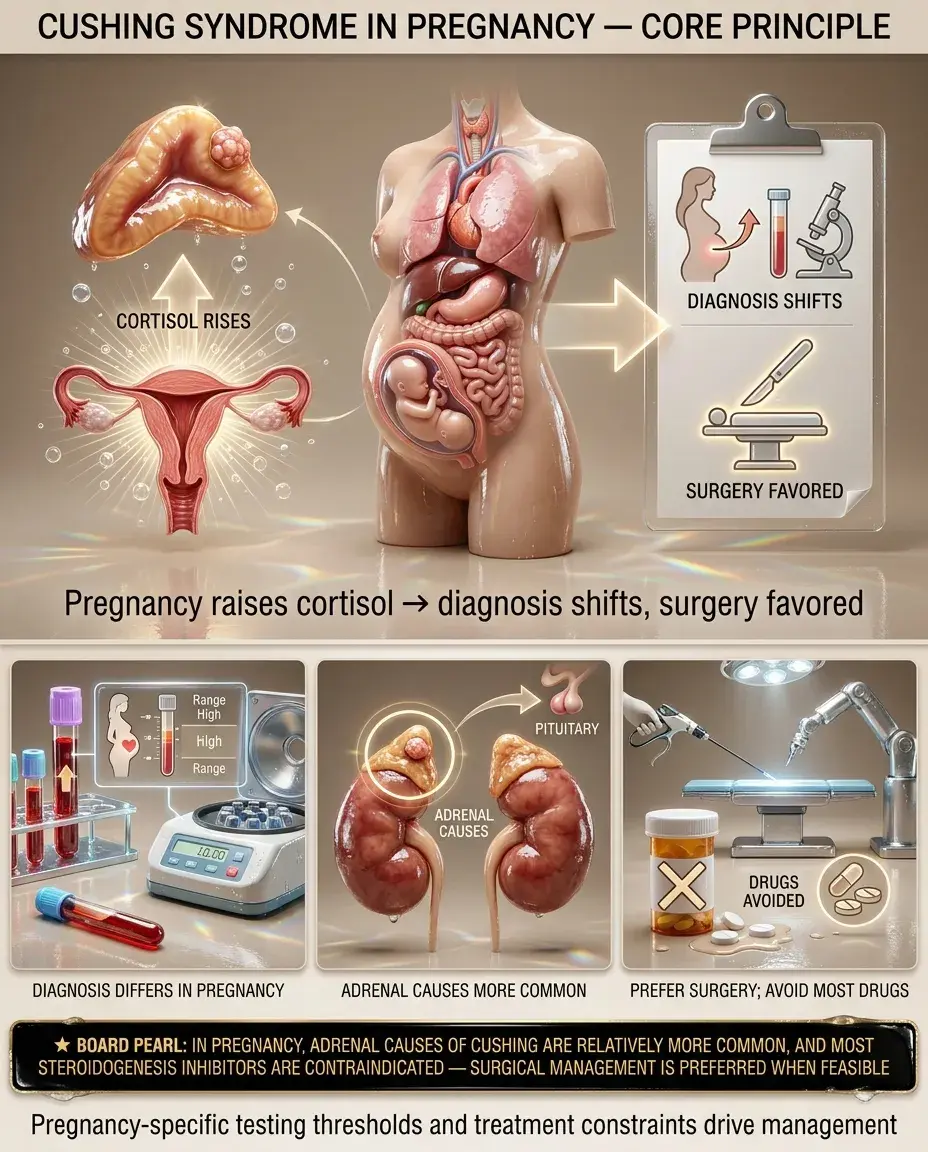
Cushing syndrome in pregnancy is rare but high-risk → ↑ preeclampsia, gestational DM, preterm delivery, fetal loss
Diagnosis is challenging:
Etiology: adrenal adenoma is proportionally more common in pregnancy-associated Cushing (unlike non-pregnant where pituitary predominates)
Adrenal adenoma → laparoscopic adrenalectomy in 2nd trimester if necessary
Metyrapone: safest steroidogenesis inhibitor in pregnancy (limited data); monitor BP (can worsen HTN)
Ketoconazole: contraindicated (teratogenic — anti-androgen effects)
Mifepristone: contraindicated (abortifacient — anti-progesterone activity)
Mitotane: contraindicated (teratogenic, adrenolytic)
Solid White Background
Special Populations — Pediatric and Elderly

Pediatric Cushing syndrome:

Elderly:

— CRH stimulation after low-dose DST (Dex-CRH test) helps differentiate

Board pearl: In a child with obesity + short stature (or growth arrest), suspect Cushing syndrome. Simple obesity in children is associated with normal or accelerated linear growth.

Growth deceleration with simultaneous weight gain — key distinguishing feature from exogenous obesity (where children grow tall)
Cushing disease (pituitary) is the most common endogenous cause in children >7 years
Adrenal causes more common in children <7 years
Diagnosis: same screening tests; UFC indexed to body surface area
Treatment: TSS for pituitary disease; adrenalectomy for adrenal tumors
Catch-up growth expected after successful treatment
Cushing syndrome accelerates osteoporosis, sarcopenia, cognitive decline, cardiovascular risk
Higher surgical morbidity → more often treated medically initially or with radiation
Must distinguish from pseudo-Cushing states: depression, alcoholism, poorly controlled DM
Solid White Background
Complications and Emergencies

— Perioperative VTE prophylaxis is essential for Cushing patients undergoing surgery

— Consider PCP prophylaxis (TMP-SMX) when cortisol is very high

— Particularly severe in ectopic ACTH (very high cortisol levels)

Board pearl: Severe Cushing syndrome with K⁺ <3.0, alkalosis, and very high cortisol → think ectopic ACTH source until proven otherwise.

Cardiovascular: HTN (~80%), accelerated atherosclerosis, DVT/PE (hypercoagulable state — cortisol ↑ clotting factors)
Metabolic: DM/impaired glucose tolerance (~60%), dyslipidemia, metabolic syndrome
Infectious: immunosuppression → bacterial, fungal (Pneumocystis jirovecii), atypical infections
Musculoskeletal: osteoporosis, vertebral fractures, avascular necrosis, proximal myopathy
Psychiatric: depression (most common), psychosis, mania, suicidality
Hypokalemic metabolic alkalosis: cortisol overwhelms 11β-HSD2 → acts on mineralocorticoid receptor → Na⁺ retention, K⁺ wasting, HTN
Solid White Background
Adrenal Crisis and Post-Treatment Adrenal Insufficiency

After successful treatment of Cushing syndrome (TSS, adrenalectomy), the HPA axis is suppressed:

Adrenal crisis:

Board pearl: Post-curative surgery for Cushing, feeling worse (fatigue, myalgia, arthralgias) is expected — "glucocorticoid withdrawal syndrome" — may persist for months; gradual taper and patient education are essential.

Contralateral adrenal (or remaining normal corticotrophs) is atrophied from chronic negative feedback
Patients develop secondary adrenal insufficiency postoperatively
Must be placed on physiologic glucocorticoid replacement (hydrocortisone 15–20 mg/day or equivalent)
Taper gradually over 6–18 months with periodic morning cortisol and/or cosyntropin stimulation testing
Precipitants: abrupt steroid withdrawal, surgical stress without stress-dose steroids, infection
Presentation: hypotension, shock, ↓ Na⁺, ↑ K⁺ (if primary), nausea/vomiting, altered mental status
Next best step: IV hydrocortisone 100 mg bolus → 50 mg q8h + aggressive IV normal saline
Do NOT wait for lab confirmation — treat empirically if suspected
Solid White Background
Key Differentials — Pseudo-Cushing States

Pseudo-Cushing states mimic biochemical hypercortisolism without true autonomous cortisol excess:

How to distinguish:

Key distinction: In pseudo-Cushing, the HPA axis is functionally overactive but not autonomous. In true Cushing, there is autonomous cortisol production that escapes normal feedback.

Major depressive disorder
Chronic alcoholism ("alcohol-induced pseudo-Cushing")
Morbid obesity
Poorly controlled DM
Obstructive sleep apnea
Intense physical stress, critical illness
Clinical: pseudo-Cushing typically lacks discriminatory signs (purple striae, proximal myopathy, easy bruising, thin skin)
Dex-CRH test: give 0.5 mg dex q6h × 48h → then CRH stimulation → cortisol >1.4 μg/dL suggests true Cushing; cortisol suppressed = pseudo-Cushing
Late-night salivary cortisol: loss of diurnal rhythm favors true Cushing
Resolution of abnormal biochemistry after treating the underlying condition (e.g., alcohol cessation, depression treatment) confirms pseudo-Cushing
Solid White Background
Key Differentials — Other Hypercortisolism Mimics and Overlapping Conditions

— ↑ cortisol effects but ↓ ACTH, ↓ endogenous cortisol; synthetic steroids (prednisone, dexamethasone) may not be detected by cortisol assays → low measured cortisol with clinical Cushing features

— Always take a thorough medication history including topical, inhaled, intra-articular steroids

— Shares hirsutism, acne, menstrual irregularity, obesity

— Lacks catabolic features (striae, myopathy, bruising)

— Normal cortisol, ↑ androgens, ↑ LH:FSH ratio

— Central obesity, HTN, DM, dyslipidemia overlap

— Normal 24-hour UFC, normal late-night salivary cortisol, normal DST

— Mild autonomous cortisol secretion without overt Cushing phenotype

— Diagnosed by 1-mg DST (cortisol >1.8 μg/dL) + ↓ ACTH

— May contribute to HTN, DM, osteoporosis

— Consider surgery if metabolic comorbidities are attributable

Board pearl: Subclinical Cushing from an adrenal incidentaloma is increasingly tested — screen all adrenal incidentalomas with a 1-mg overnight DST.

Exogenous glucocorticoid use:
Polycystic ovary syndrome (PCOS):
Metabolic syndrome / simple obesity:
Adrenal incidentaloma with subclinical Cushing:
Solid White Background
Screening Intervals and Who to Screen

Who should be screened for Cushing syndrome:

Screening approach:

Post-treatment surveillance:

Board pearl: Cushing disease can recur years after seemingly successful surgery — long-term biochemical surveillance is mandatory.

Patients with multiple progressive features of hypercortisolism (especially discriminatory signs)
Adrenal incidentaloma (all patients)
Young patients with osteoporosis or vertebral fractures without clear cause
Poorly controlled DM/HTN with cushingoid features
Children with weight gain + growth arrest
Start with ≥2 of: 24h UFC, late-night salivary cortisol (×2), 1-mg overnight DST
If all normal and low clinical suspicion → Cushing unlikely; retest in 6–12 months if suspicion persists
If equivocal → repeat testing or use Dex-CRH test
After TSS for Cushing disease: assess morning cortisol within 24–72h postop (cortisol <2 μg/dL = remission)
Monitor for recurrence: annual 24h UFC or late-night salivary cortisol for ≥10 years
Recurrence rate after TSS: 15–25% over 10 years
Solid White Background
Follow-Up, Monitoring, and Recovery After Treatment

— Postop hydrocortisone (10–12 mg/m²/day); taper by 20–25% every 1–3 months guided by symptoms and AM cortisol

— Cosyntropin stimulation test: cortisol >18 μg/dL at 30 or 60 min → HPA axis recovered → can discontinue replacement

— DM may improve or resolve → ↓ insulin/oral hypoglycemic doses gradually

— HTN: antihypertensives may need reduction

— Osteoporosis: repeat DEXA at 1–2 years; consider bisphosphonate if persistent osteoporosis

— Psychiatric symptoms: may take months to improve; screen for ongoing depression

Next best step after surgical cure: Educate patient on stress dosing, taper plan, and need for long-term recurrence surveillance.

Glucocorticoid replacement taper:
Comorbidity monitoring:
VTE risk: remains elevated perioperatively → prophylaxis with LMWH for 4–6 weeks postop in some protocols
Body composition: central obesity, myopathy improve over 6–12 months; encourage progressive resistance exercise
Stress dosing education: patients on glucocorticoid replacement must increase dose during illness/surgery until HPA axis recovers (same principles as adrenal insufficiency management)
Solid White Background
Ethical, Legal, and Patient Safety Considerations

— Physicians must counsel patients on risks of long-term glucocorticoid therapy before initiating

— Never abruptly discontinue chronic steroids → adrenal crisis risk

— Document steroid taper plan; ensure all providers are aware

Board pearl: All patients on chronic exogenous glucocorticoids or post-Cushing glucocorticoid replacement must receive sick-day rules and carry emergency injectable hydrocortisone.

Iatrogenic Cushing syndrome:
Informed consent for TSS: discuss risks (CSF leak, hypopituitarism, DI, recurrence, need for lifelong monitoring)
Medical emergency bracelet: all patients on glucocorticoid replacement post-treatment should wear medical alert identification
Psychiatric safety: Cushing patients have high rates of depression, anxiety, and suicidality → screen at every visit; psychiatric comorbidity may persist after biochemical cure
Shared decision-making: when multiple treatment options exist (re-operation vs. radiation vs. medical therapy for recurrent disease), engage patient in goals-of-care discussion
Medication safety: ketoconazole → hepatotoxicity (LFT monitoring mandatory); mitotane → narrow therapeutic window; mifepristone → cannot use cortisol to monitor
Solid White Background
High-Yield Associations and Rapid-Fire Clinical Facts

Board pearl: A patient with bilateral adrenalectomy for Cushing who develops progressive hyperpigmentation and enlarging pituitary mass → Nelson syndrome.

Cushing disease = pituitary ACTH-secreting adenoma (most common endogenous cause)
Most common overall cause of Cushing syndrome = exogenous glucocorticoids
BIPSS = gold standard to confirm pituitary vs. ectopic ACTH source
Nelson syndrome = post-bilateral adrenalectomy → loss of cortisol feedback → aggressive pituitary corticotroph tumor expansion + severe hyperpigmentation
Ectopic ACTH pearls: hypokalemic metabolic alkalosis, rapid onset, no typical cushingoid body habitus, associated with small cell lung CA and bronchial carcinoid
Purple striae >1 cm = most specific physical finding for Cushing syndrome
Cortisol overwhelms 11β-HSD2 → mineralocorticoid effect → HTN + hypokalemia
Cyclic Cushing: intermittent cortisol secretion → may require repeated testing
MEN-1: pituitary adenoma + parathyroid hyperplasia + pancreatic neuroendocrine tumors
CRH-secreting tumors (hypothalamic, ectopic): very rare; cause ACTH-dependent Cushing
Carney complex: PPNAD + cardiac myxoma + skin lentigines
McCune-Albright: GNAS mutation → ACTH-independent adrenal hyperplasia
Solid White Background
Board Question Stem Patterns
35F, weight gain, purple striae, moon facies, proximal weakness, glucose 250 → Suspect Cushing syndrome → order 24h UFC + late-night salivary cortisol or 1-mg overnight DST
Confirmed hypercortisolism, ACTH 85 pg/mL, no suppression on high-dose DST, pituitary MRI normal → Ectopic ACTH → CT chest (bronchial carcinoid) + BIPSS to confirm
Elevated UFC ×2, ACTH 55 pg/mL, >50% cortisol suppression on high-dose DST, pituitary MRI shows 8 mm adenoma → Cushing disease → transsphenoidal surgery
Post-TSS cortisol 1.2 μg/dL on postop day 2 → Successful remission → start hydrocortisone replacement, taper over months
48M, rapid-onset HTN, K⁺ 2.8, alkalosis, cortisol 68 μg/dL, ACTH 250 pg/mL → Ectopic ACTH (likely SCLC) → CT chest + medical cortisol control (ketoconazole/metyrapone or etomidate if critical)
Confirmed hypercortisolism, ACTH <5 pg/mL → ACTH-independent → CT adrenals → adrenal adenoma vs. carcinoma
Child with obesity + growth arrest + purple striae → Cushing syndrome (NOT simple obesity — simple obesity causes tall stature in children)
Obese patient, mild UFC elevation, depression → Pseudo-Cushing → Dex-CRH test to differentiate
Adrenal incidentaloma, mild HTN, DM, cortisol 4.5 after 1-mg DST, ACTH low → Subclinical Cushing → consider adrenalectomy if metabolic morbidity attributable
Solid White Background
One-Line Recap
Cushing syndrome results from chronic glucocorticoid excess — most commonly iatrogenic, with endogenous cases predominantly ACTH-dependent (pituitary Cushing disease > ectopic ACTH) — diagnosed by confirming hypercortisolism with ≥2 screening tests (24h UFC, late-night salivary cortisol, 1-mg overnight DST), then localizing the source via ACTH level (ACTH-dependent → high-dose DST/CRH stimulation/MRI/BIPSS; ACTH-independent → adrenal CT), treated primarily with surgical resection (transsphenoidal surgery for pituitary disease, adrenalectomy for adrenal tumors, tumor resection for ectopic ACTH) followed by glucocorticoid replacement during HPA axis recovery, with medical therapy (ketoconazole, metyrapone, osilodrostat, mifepristone, pasireotide) reserved for surgical failure or bridging, and long-term surveillance for recurrence mandated for ≥10 years.
Solid White Background
Previous Item
Next Item
bottom of page