top of page

eduo
visual

Biostatistics & Epidemiology
International Health Organizations: WHO, CDC, UN, GAVI
Core Principle of International Health Organizations
🧷
International health organizations coordinate global responses to health threats, establish standards, provide technical assistance, and mobilize resources to address health disparities between nations.
🧷
They operate through multilateral cooperation, combining surveillance, policy development, emergency response, and capacity building to protect population health across borders.
🧷
Understanding their distinct roles, funding mechanisms, and operational frameworks is essential for recognizing how global health initiatives translate to local implementation.
🧷
Board pearl: Questions often test the specific mandate of each organization — WHO sets standards, CDC provides technical expertise, UN coordinates humanitarian response, GAVI ensures vaccine access.

World Health Organization (WHO) Structure and Mandate
📍
WHO is the United Nations' specialized agency for health, established in 1948 with 194 member states.
📍
Core functions: setting international health standards (International Health Regulations), disease surveillance, coordinating emergency responses, and providing technical guidance.
📍
Governed by the World Health Assembly (annual meeting of all member states) which sets policy and approves the budget.
📍
Six regional offices (Americas/PAHO, Africa, Europe, Eastern Mediterranean, Western Pacific, Southeast Asia) adapt global strategies to regional contexts.
📍
Board pearl: WHO can declare a Public Health Emergency of International Concern (PHEIC) but cannot enforce compliance — sovereignty remains with member states.

WHO International Health Regulations (IHR)
🔹
IHR (2005) is a legally binding agreement requiring countries to report certain disease outbreaks and public health events to WHO within 24 hours.
🔹
Notifiable diseases include: smallpox, wild-type polio, novel influenza, SARS, and any event of potential international concern.
🔹
Countries must maintain core surveillance and response capacities at ports, airports, and ground crossings.
🔹
The IHR balances public health protection with minimizing interference to international traffic and trade.
🔹
Board distinction: IHR notification is mandatory for member states, but WHO recommendations during emergencies are non-binding guidance.

WHO Emergency Response Framework
⭐
WHO's Health Emergencies Programme coordinates responses to outbreaks, humanitarian crises, and natural disasters.
⭐
Emergency Response Framework includes risk assessment, Emergency Medical Teams coordination, and the Global Outbreak Alert and Response Network (GOARN).
⭐
Strategic Health Operations Centre (SHOC) operates 24/7 for real-time monitoring and coordination.
⭐
Contingency Fund for Emergencies provides rapid funding within 24-48 hours of crisis onset.
⭐
Board pearl: WHO grades emergencies from 1 (minimal) to 3 (substantial international response required) — Grade 3 triggers maximum organizational response.

Centers for Disease Control and Prevention (CDC) Global Role
✅
CDC is the U.S. federal agency for disease control, but operates globally through country offices, technical assistance, and outbreak response.
✅
Global programs include: President's Emergency Plan for AIDS Relief (PEPFAR) implementation, Global Disease Detection centers, and Field Epidemiology Training Programs.
✅
CDC provides laboratory expertise, epidemiologic investigation, and capacity building that many countries lack.
✅
Epidemic Intelligence Service (EIS) officers deploy internationally for outbreak investigations.
✅
Board pearl: Unlike WHO which sets policy, CDC provides hands-on technical implementation and trains the global public health workforce.

CDC's Global Health Security Agenda
🧠
Global Health Security Agenda (GHSA) launched in 2014 to build countries' capacities to prevent, detect, and respond to infectious disease threats.
🧠
Focus areas: antimicrobial resistance surveillance, laboratory systems strengthening, real-time disease surveillance, and emergency operations centers.
🧠
CDC supports implementation through direct funding, embedding staff in ministries of health, and technology transfer.
🧠
Measurable targets include reducing time from outbreak to detection and response.
🧠
Board clue: GHSA represents the shift from reactive outbreak response to proactive capacity building in vulnerable countries.

United Nations Health-Related Agencies
⚡
Multiple UN agencies address health through their specific mandates — understanding which agency leads in different contexts is board-relevant.
⚡
UNICEF: child health, immunization programs, nutrition, and emergency response for children.
⚡
World Food Programme (WFP): addresses malnutrition and food security during emergencies.
⚡
UNDP: health system strengthening and addressing social determinants.
⚡
UNHCR: refugee health services and coordination in humanitarian settings.
⚡
Board pearl: In refugee crises, UNHCR coordinates health response, not WHO — each UN agency has a defined role to prevent duplication.

UN Sustainable Development Goals and Health
📌
SDG 3 "Ensure healthy lives and promote well-being for all" includes specific targets for maternal mortality, communicable diseases, NCDs, and universal health coverage by 2030.
📌
Health appears across multiple SDGs — SDG 2 (nutrition), SDG 6 (water/sanitation), SDG 11 (air pollution), demonstrating health's intersectoral nature.
📌
Progress monitored through standardized indicators reported annually by countries.
📌
SDGs replaced Millennium Development Goals (MDGs) with broader scope and emphasis on equity.
📌
Board distinction: MDGs focused on specific diseases; SDGs emphasize health systems strengthening and universal health coverage.

GAVI, the Vaccine Alliance Structure
📣
GAVI is a public-private partnership created in 2000 to increase vaccine access in the world's poorest countries.
📣
Partners include: WHO (technical standards), UNICEF (vaccine procurement), World Bank (financial management), Bill & Melinda Gates Foundation (funding), and vaccine manufacturers.
📣
Focuses on countries with GNI per capita below $1,630, covering approximately half the world's children.
📣
Innovative financing mechanisms include Advanced Market Commitments and the International Finance Facility for Immunisation.
📣
Board pearl: GAVI specifically addresses the vaccine access gap — making vaccines available and affordable, not developing new vaccines.

GAVI's Market Shaping and Vaccine Introduction
🔸
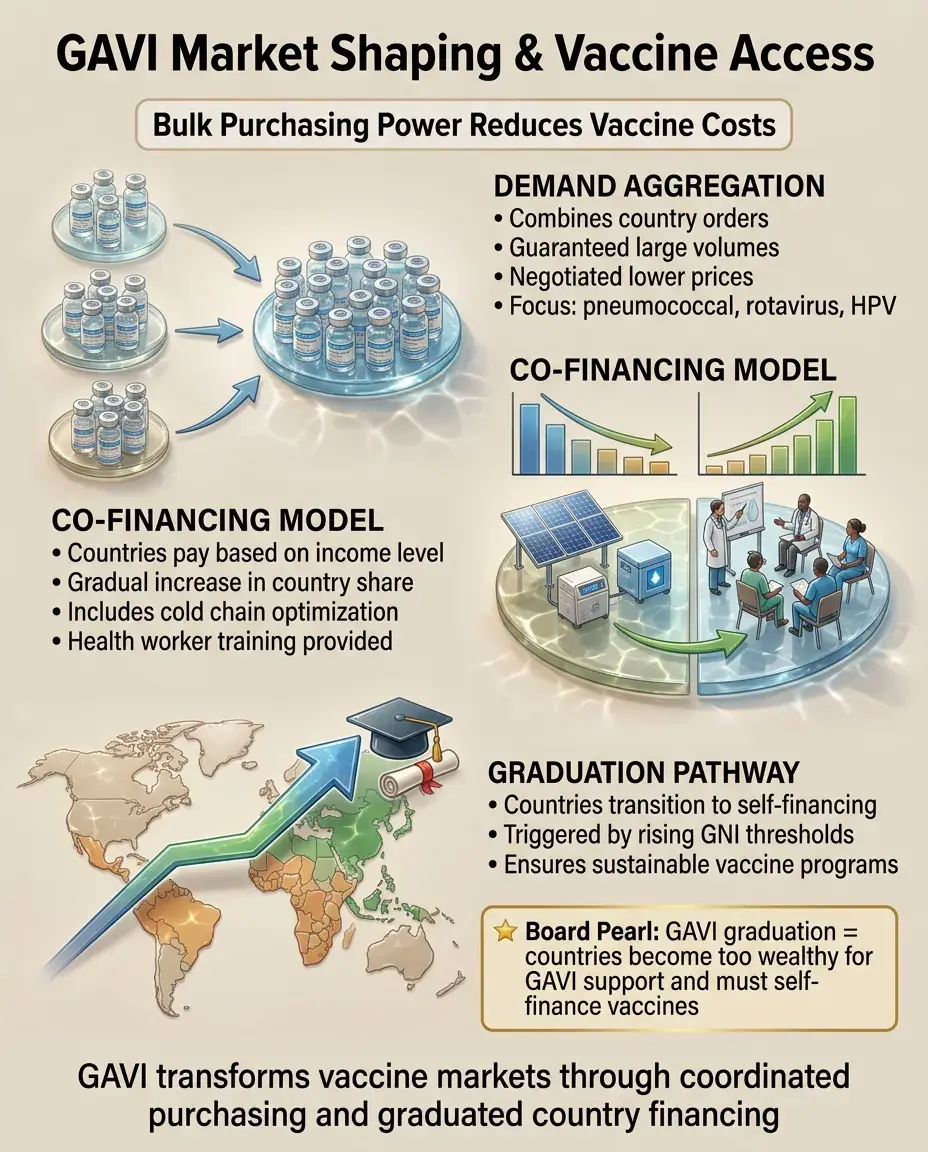
GAVI aggregates demand from eligible countries to negotiate lower vaccine prices through guaranteed large-volume purchases.
🔸
Supports introduction of new vaccines (pneumococcal, rotavirus, HPV) that would otherwise be unaffordable.
🔸
Countries co-finance vaccines based on income level, gradually increasing their share as economies grow.
🔸
Cold chain equipment optimization and health worker training accompany vaccine introduction.
🔸
Board clue: GAVI's graduation process — countries transition to self-financing vaccines as their GNI rises above the eligibility threshold.
Coordination Mechanisms Between Organizations
🧷
The Global Health Security Agenda synchronizes efforts between WHO technical standards, CDC implementation support, and donor funding.
🧷
During emergencies, the Inter-Agency Standing Committee activates health clusters led by WHO with operational partners.
🧷
The International Health Partnership (IHP+) aligns donor support with country health plans to reduce fragmentation.
🧷
Joint External Evaluations assess country capacities using teams from multiple organizations.
🧷
Board pearl: Despite different mandates, organizations must coordinate to avoid duplication — WHO leads policy while others support implementation.

Funding Mechanisms and Budget Constraints
📍
WHO budget comprises assessed contributions (mandatory dues from member states) and voluntary contributions (80% of budget, often earmarked for specific programs).
📍
CDC global programs funded through congressional appropriations, making them subject to political changes.
📍
GAVI uses innovative financing: donor pledges, private foundation support, and bond markets (IFFIm).
📍
Funding unpredictability affects long-term planning and emergency response capacity.
📍
Board distinction: Assessed vs. voluntary contributions — assessed provide flexibility while voluntary contributions control how funds are used.

Disease Eradication and Elimination Programs
🔹
WHO leads global eradication initiatives requiring coordination across all countries — smallpox (eradicated 1980), polio (ongoing), guinea worm (near eradication).
🔹
Eradication means permanent reduction to zero worldwide; elimination means zero incidence in a geographic region.
🔹
Success requires sustained political commitment, funding, surveillance systems, and addressing the last resistant pockets.
🔹
Certification process validates countries are disease-free through independent commission review.
🔹
Board pearl: Only smallpox has been eradicated; polio remains endemic in Afghanistan and Pakistan despite decades of effort.

Pandemic Preparedness and Response
⭐
WHO's Pandemic Influenza Preparedness Framework enables virus sharing and benefit sharing (vaccines, antivirals) between countries.
⭐
The R&D Blueprint identifies priority pathogens for vaccine/therapeutic development before outbreaks occur.
⭐
CEPI (Coalition for Epidemic Preparedness Innovations) funds vaccine development for epidemic threats.
⭐
Access to COVID-19 Tools Accelerator (ACT-A) coordinates equitable access to diagnostics, treatments, and vaccines.
⭐
Board clue: Pandemic preparedness shifted from reactive to proactive after H1N1 — now includes pre-positioned supplies and predetermined response protocols.

Health Information Systems and Global Standards
✅
WHO maintains International Classification of Diseases (ICD-11) as the global standard for mortality and morbidity reporting.
✅
Global Health Observatory aggregates health statistics from all member states for monitoring and comparison.
✅
CDC develops and shares surveillance platforms (Epi Info) used globally for outbreak investigation.
✅
Demographic and Health Surveys provide standardized health data from developing countries.
✅
Board pearl: ICD coding enables global health comparisons but depends on country capacity for accurate vital registration.

Antimicrobial Resistance Global Response
🧠
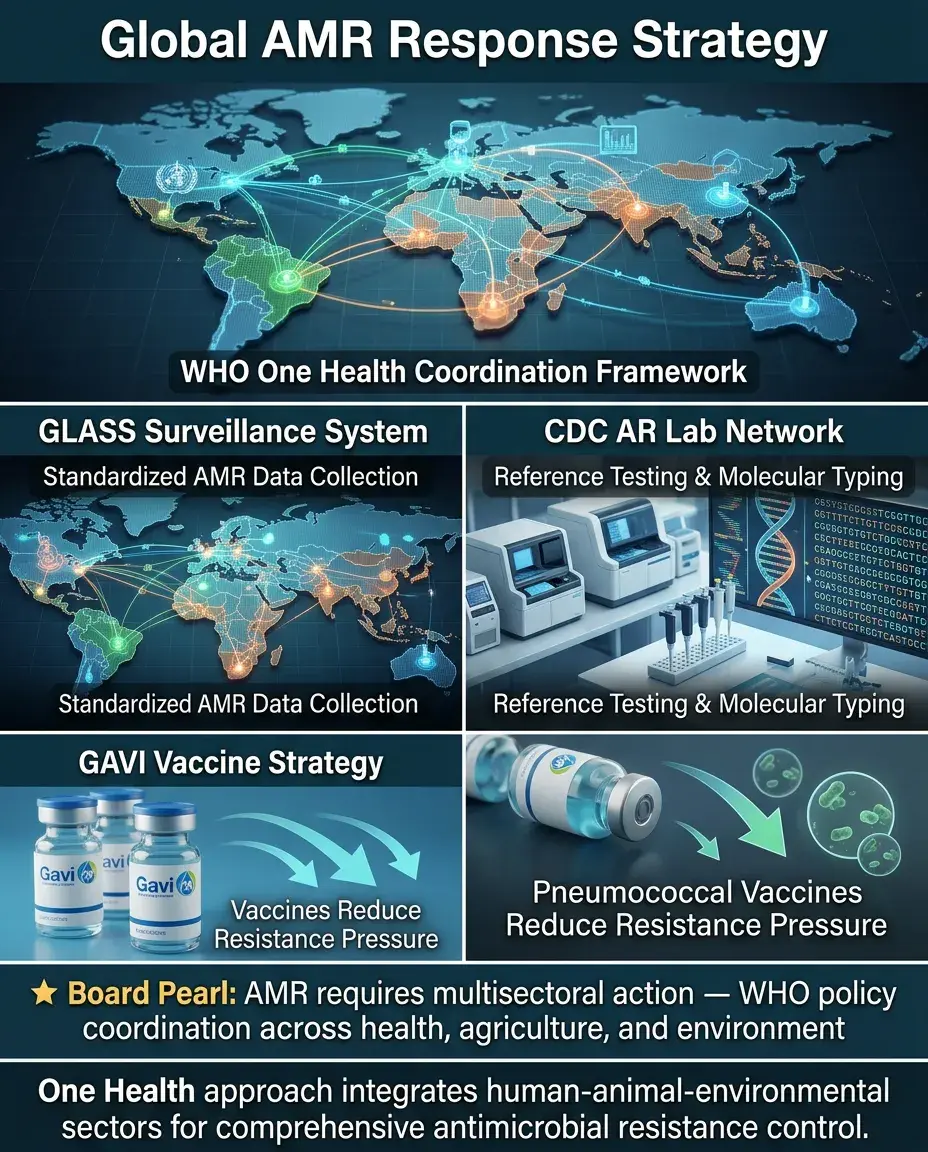
WHO Global Action Plan on AMR adopted by all member states in 2015 with One Health approach (human, animal, environmental).
🧠
Global Antimicrobial Resistance Surveillance System (GLASS) standardizes AMR data collection across countries.
🧠
CDC's AR Lab Network provides reference testing and molecular typing globally.
🧠
GAVI introduces pneumococcal vaccines partly to reduce antibiotic use and resistance pressure.
🧠
Board distinction: AMR requires multisectoral action — WHO coordinates policy while implementation involves health, agriculture, and environment sectors.
Humanitarian Health Response Coordination
⚡
In humanitarian emergencies, the Health Cluster approach led by WHO coordinates all health actors to prevent gaps and overlaps.
⚡
UN Central Emergency Response Fund provides immediate funding for life-saving health interventions.
⚡
Sphere Standards establish minimum standards for health services in humanitarian response.
⚡
Emergency Medical Teams are classified and quality assured by WHO for deployment.
⚡
Board pearl: Health cluster activation occurs when national capacity is overwhelmed — WHO coordinates but doesn't replace government leadership.

Global Health Governance Challenges
📌
Tension between national sovereignty and global health security — countries may delay reporting outbreaks fearing economic consequences.
📌
Vertical (disease-specific) vs. horizontal (health system) approaches compete for limited resources.
📌
Brain drain of health workers from low to high-income countries undermines capacity building efforts.
📌
Donor priorities may not align with country needs, creating parallel systems.
📌
Board clue: Global health governance lacks enforcement mechanisms — compliance relies on peer pressure, technical support, and aligned incentives.

Board Question Stem Patterns
📣
Country reports novel respiratory virus with human transmission → WHO notification required within 24 hours under IHR.
📣
Refugee camp needs health coordination → UNHCR leads with WHO technical support.
📣
New vaccine too expensive for poor countries → GAVI negotiates price and provides co-financing.
📣
Country requests outbreak investigation support → CDC Epidemic Intelligence Service deployment.
📣
Setting global vaccination coverage targets → WHO through World Health Assembly resolution.
📣
Innovative financing for pandemic preparedness → CEPI or pandemic bonds through World Bank.
📣
Standardizing disease reporting globally → WHO ICD classification system.

One-Line Recap
🔸
International health organizations form an ecosystem where WHO sets standards and coordinates emergency response, CDC provides technical implementation and workforce development, UN agencies address health within their specialized mandates (refugees, children, food security), and GAVI ensures vaccine equity — all requiring complex coordination mechanisms to transform global policies into local health improvements while navigating sovereignty, funding constraints, and competing priorities.

bottom of page